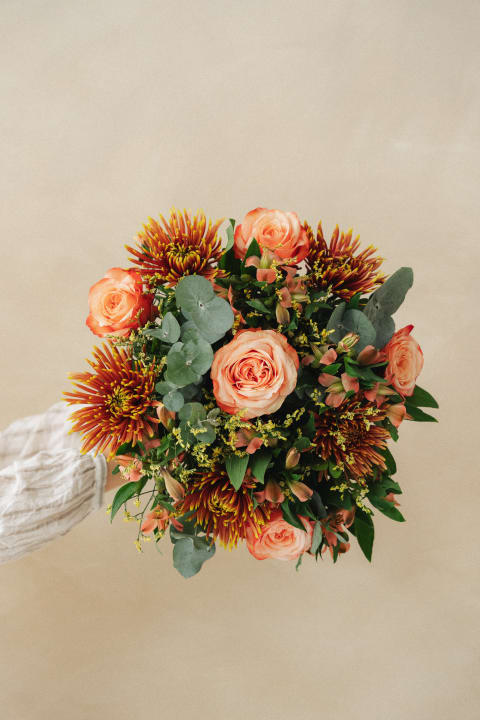
If your recipient is out when the driver arrives, the bouquet is usually left at the door or in a safe place, and the recipient receives a WhatsApp message saying that flowers have arrived for them. It travels in a cardboard box with its stems sitting in a water reservoir, so it is protected on the way.
That is the honest answer. Everything else on this page is about making sure someone is in, or that the “safe place” really is safe.
What happens, step by step
- The driver arrives at the address on the order and looks for the name you gave (or the c/o name) on the doorbells.
- If someone answers, they hand over the box. Done.
- If nobody answers, the bouquet is usually left at the door or in a safe place.
- The recipient receives a WhatsApp message saying flowers have arrived, so they know to look as soon as they get home.
This is why the recipient’s mobile number matters so much. Without it, a bouquet left in a safe place may wait longer than it needs to before anyone notices it.
Six ways to reduce the risk
1. Choose the day with care
You can choose a delivery date up to 14 days ahead, so pick a day when your recipient is likely to be in, rather than defaulting to “as soon as possible”. Remember the calendar:
- Canton of Geneva: same-day delivery for orders before 2 pm, Monday to Saturday.
- Rest of Switzerland: next-day delivery for orders before 4 pm, Tuesday to Saturday. For Saturday, order by 4 pm on Friday.
- No Sunday delivery anywhere.
Saturday is often the day people are home. If you are aiming for it outside Geneva, order by Friday afternoon. Public holidays differ by canton and can also change who is around; check our public holidays by canton table.
2. Use a time slot
In Geneva, pick the slot that matches their routine: 9 am–2 pm for someone who works afternoons, 5 pm–8 pm for someone who is out all day. Elsewhere, deliveries run between 7 am and 6 pm; the optional morning slot (9 am–12 pm, CHF 5 extra) is useful for parents at home in the morning, retired recipients, or anyone you know leaves after lunch.
3. Give the recipient’s mobile number
Include the country code (+41 for a Swiss number). It is the single most useful field on the order after the address itself: it lets the recipient know their flowers are waiting, and it gives the driver a way to reach them.
If you are planning a surprise and do not want to ask the recipient directly, ask their partner, flatmate or a colleague for the mobile number and the name on the doorbell at the same time.
4. Write a safe-place note
Use the delivery note to suggest where the bouquet should wait if nobody answers. Good examples:
- “If no answer, please leave with the concierge on the ground floor.”
- “Neighbour on 2nd floor right (bell: MEIER) is expecting it.”
- “Covered porch at the back, behind the bench.”
Avoid places in full sun, next to a radiator in a stairwell, or anywhere exposed to frost. A short, specific note helps the driver choose well.
5. Get the bell right
A name that is not on the doorbell is easy to overlook when you order: a new arrival, a flatshare, a guest. Our page on the name on the letterbox explains how to use a c/o line, and the address guide covers floors and entrances.
6. Send it to work instead
If your recipient is out all day, every day, deliver to their office on a weekday. Reception is staffed, there are fixed hours, and colleagues will notice the flowers. Our office delivery guide explains how to write a company address and why the morning slot is worth it.
Special cases
Hospitals. KANEL delivers to the front desk of hospitals, so “nobody home” does not arise in the same way. The challenges there are different: the right ward and the hospital’s rules. See hospitals and clinics.
Holiday homes and chalets. If you are sending to someone on holiday in the mountains, make sure the address is the chalet or hotel they are actually staying in, with the name under which the booking was made as a c/o line.
Hotels. Address the bouquet to the guest, c/o the hotel, and mention the arrival date in the note so reception knows who it is for.
Long absences. If you know the recipient is away, simply move the date. With up to 14 days to choose from, there is rarely a reason to send flowers to an empty home.
Elderly relatives. Older recipients may not hear the bell, or may take a while to reach the door. Mention it in the note (“please ring twice and wait a moment, 3rd floor”), and if a neighbour or carer is usually around, name them as a fallback.
A quick pre-order checklist
- Date chosen for a day they are likely to be in (and not a Sunday).
- Slot chosen if you are in Geneva, or morning slot elsewhere if that suits.
- Recipient’s mobile number entered.
- Safe-place note written.
- Name on the bell checked, or c/o line added.
Once those are done, choose the bouquet. The seasonal bouquets start at CHF 74.90 and change with the weeks, and the timeless range starts at CHF 64.90. A message card is free from CHF 55, and the code KANEL5 takes 5 % off at checkout.